
The main objective of this paper is to evaluate the seismic Seismic Evaluation response of buildings of typical reinforced concrete frames when concrete starts to deteriorate gradually and to make a comparison between the base shear and the displacement at different stages of earthquake loading. Typical 5, 15, 20 and 30-storey reinforced concrete frames have been designed for seismicity according to the recently adopted seismic code in Abu Dhabi, ACI 318-08/IBC 2009 code. A pushover analysis has been performed to these four buildings by using SAP 2000. Twenty-four models have been created (6 models for each building) by decreasing the concrete strength gradually from 4000 psi (281 kg/cm2) to 1500 psi (105 kg/cm2). This is to simulate the effect of harsh environment on the strength of concrete in existing buildings.
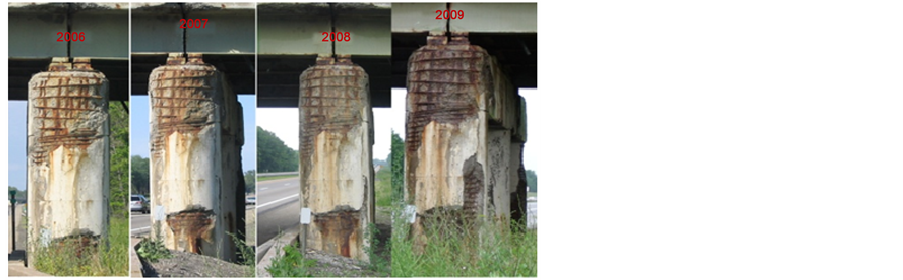
It is well known that Abu Dhabi has witnessed seismic activities in recent years. Besides, the design of buildings in Abu Dhabi did not take into consideration the effect of earthquakes until 1997. It is expected that larger stock of existing buildings in Abu Dhabi is at risk due to the combined effect of the harsh environment and expected earthquake activity, so analytical model is needed to find out the effect of the harsh environment or concrete deterioration on the existing buildings in Abu Dhabi. Abu Dhabi is located in the Arabian Gulf region which is well known for its harsh environment. The city of Abu Dhabi has witnessed an extensive urbanization development during the last three decades and the concrete has been the most widely used construction material. It is well known that the prevailing harsh environment in Abu Dhabi leads to lower strength of concrete with time. Figure 1 shows concrete deterioration by time.
Four two-bay frame models are used to represent typical construction of buildings in Abu Dhabi and designed according to ACI 318-08 [1] and IBC 2009 [2] building codes. The typical bay width and story height of the frame model are 5.0 and 3.0 m, respectively. The ground floor height is 5.0 m to take into account the foundation depth. Since Abu Dhabi is located in the Arabian Gulf region the common soils in Abu Dhabi are generally classified as weak soils, and hence, the buildings are usually founded on piles. The four models neglected the effect of torsion in buildings subjected to earthquakes assuming that the center of mass of the building coincides with the center of rigidity of its columns. The selected numbers of stories of RC buildings considered are 5, 15, 20 and 30 storeys. Figure 2 represents one of them.